10 AI Cliche Phrases to Cut From Your Cover Letter
Learn the 10 common AI cliché phrases to avoid in your cover letter. Discover how to replace generic statements with specific achievements and create a natural, personalized, and professional cover letter with CV Labz.
Writing a strong cover letter is not about using impressive words. It is about showing an employer why your experience, skills, and interest make sense for the role. Yet cover letters now rely on polished phrases that sound professional but do not actually say much.
This has become even more noticeable with AI-assisted writing. AI tools help organize ideas and improve grammar, but using their suggestions without personalizing them makes your application sound generic. Phrases such as “I am a results-driven professional” or “I am excited to leverage my skills” could describe almost anyone.
The goal is not to avoid AI completely. It is to make sure your final letter sounds like you. In this guide, we will look at 10 common AI-style phrases to remove, what to write instead, and how to write a cover letter that feels specific and genuine. At CV Labz, our Cover Letter Maker helps you create a professional cover letter by organizing your skills, experience, and key information into a clear structure.
Why AI Cliches Make Cover Letters Weaker
A recruiter does not need another collection of polished statements. They need evidence that you understand the position and have something relevant to offer.
1. They Sound Generic
Recruiters read dozens of applications for the same position. When every candidate uses phrases like “passionate professional” or “proven track record,” those statements lose their impact.
A strong cover letter should tell the employer something specific about your background, rather than simply using language that sounds impressive.
2. They Replace Evidence With Empty Claims
Consider this sentence: “I am a highly motivated, results-driven professional with excellent communication skills.”
It sounds positive, but there is no evidence behind it.A stronger version would be: “In my previous role, I managed client accounts worth over $200,000 and improved quarterly retention by 15%.”The second example gives the recruiter something concrete to understand and evaluate.
3. They Make Your Writing Less Personal
The best cover letters feel written for a particular company and position. If you could replace the company name and job title and send the same letter to five other employers, it probably needs more personalization.
10 AI Cliche Phrases to Remove From Your Cover Letter
Here are 10 phrases that frequently make cover letters sound repetitive or overly polished. You do not have to avoid every phrase completely. The key is to replace generic claims with specific information whenever possible.
1. “I Am Excited to Apply for This Opportunity”
There is nothing wrong with being excited about a job. The problem is that this opening tells the recruiter very little.Instead of starting with your excitement, explain why this particular position interests you.
Instead of:
“I am excited to apply for the Marketing Manager position.”
Try:
“After leading paid campaigns that increased qualified leads by 32% at my current company, I was particularly interested in your focus on performance-driven marketing.” Now the opening immediately connects your experience to the position.
2. “I Am a Results-Driven Professional”
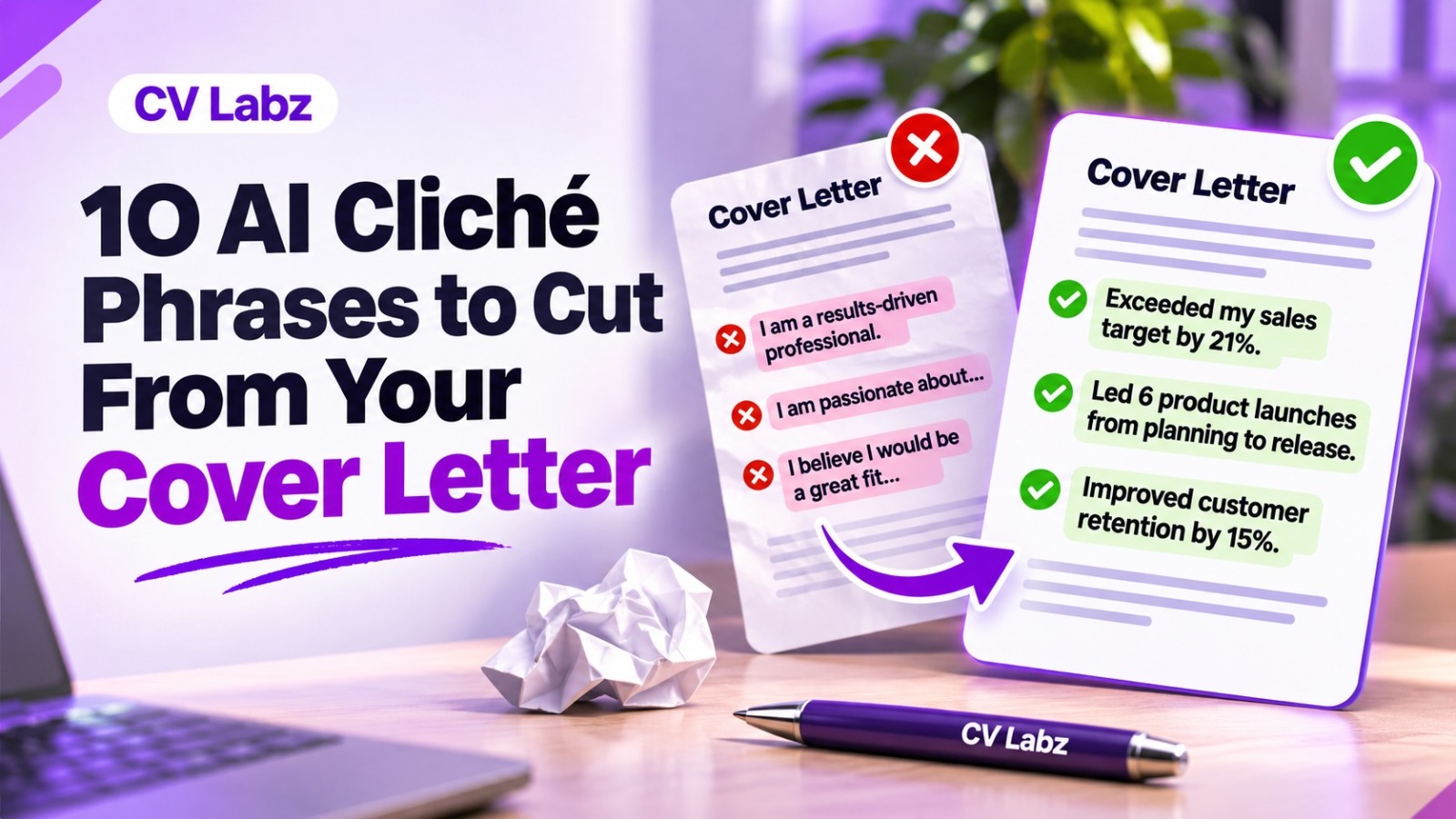
“Results-driven” is one of those phrases that sounds strong until everyone starts using it. Do not simply tell the employer that you deliver results. Show them what those results were.
Instead of:
“I am a results-driven sales professional.”
Try:
“I exceeded my annual sales target by 21% while managing a portfolio of 45 business accounts.” Specific achievements are more persuasive than broad descriptions.
3. “I Am Passionate About…”
Being passionate about your profession is useful, but simply stating it does not demonstrate your interest. Connect your interest to an experience, project, or company objective.
Instead of:
“I am passionate about product development.”
Try:
“I have spent the last three years working with design and engineering teams to turn customer feedback into product improvements.” That gives your statement context.
4. “I Believe I Would Be a Great Fit”
You should not make the recruiter take your word for it. Show the connection between your background and the job.
Instead of:
“I believe I would be a great fit for your team.”
Try:
“Your role requires experience managing cross-functional product launches, an area where I have led six launches from planning through release.” This approach makes your suitability easier to understand.
5. “In Today's Fast-Paced World”
This phrase is unnecessary in most applications. It is followed by a broad statement that could apply to almost any industry. Instead, start directly with the challenge, skill, or experience that matters to the employer.
Instead of:
“In today's fast-paced business environment, companies need adaptable professionals.”
Try:
“During my previous role, I managed three simultaneous client campaigns while coordinating deadlines across sales, design, and content teams.” The second version gets to the point immediately.
6. “Leverage My Skills and Experience”
“Leverage” has become a common corporate buzzword. There is nothing technically wrong with it, but simpler language sounds more natural. Use words such as “apply,” “use,” or describe exactly what you will do.
Instead of:
“I look forward to leveraging my skills to contribute to your company.”
Try:
“I would bring my experience in SEO and content strategy to help strengthen your organic acquisition efforts.” Now the reader understands what you actually bring.
7. “I Am Writing to Express My Interest”
This is another traditional opening that uses valuable space without providing much information. The recruiter already knows you are interested because you submitted the application.
Start with something more relevant.
Instead of:
“I am writing to express my interest in the Product Manager position.”
Try:
“After managing the launch of two SaaS products and working closely with engineering and customer success teams, I was drawn to this Product Manager opportunity.” Your opening now gives the recruiter a reason to keep reading.
8. “I Would Welcome the Opportunity to…”
This phrase frequently appears near the end of AI-generated applications. A confident closing should focus on the value you bring rather than repeating that you want an opportunity.
Instead of:
“I would welcome the opportunity to discuss my qualifications.”
Try:
“I look forward to discussing how my experience in B2B campaign management could support your growth team.” It remains professional but sounds more specific.
9. “I Am Confident That I Can Make a Valuable Contribution”
The problem is the phrase “valuable contribution.” Valuable how? Explain what you could actually contribute.
Instead of:
“I am confident that I can make a valuable contribution to your organization.”
Try:
“My experience managing regional paid campaigns and optimizing acquisition costs would allow me to contribute to your upcoming growth initiatives.” Specificity makes the statement stronger.
10. “Thank You for Your Time and Consideration”
This is a perfectly polite phrase, and there is nothing inherently wrong with using it. However, it is also extremely predictable.You keep your closing professional without making it sound like a template. For example:
“I would be glad to discuss the role and share more about my experience managing international client campaigns.” The focus stays on the conversation ahead.
What to Write Instead of AI Cliches
Removing generic phrases is only half the job. You need stronger information to replace them.
1. Use Specific Achievements
Numbers make your experience much easier to understand. Instead of saying you “improved performance,” explain how:
- Increased website conversions by 24%
- Managed a team of eight
- Reduced processing time by 30%
- Generated $500,000 in new business
- Launched a product across three markets
Not every achievement needs a number, but specific outcomes are much stronger than general claims.
2. Connect Your Experience to the Job
Read the job description carefully.Identify the two or three requirements that are most important and use your experience to demonstrate your connection to them. This also helps prevent your cover letter from simply repeating your CV.
3. Mention Something Specific About the Company
A tailored cover letter should show that you understand where you are applying. You could reference a recent product launch, company initiative, business model, market, or challenge that genuinely connects with your experience. Avoid vague statements such as “I admire your innovative company.”Explain what you actually admire and why it matters to you.
4. Write Like a Professional, Not a Template
Professional writing does not need complicated vocabulary. Shorter, clearer sentences make your application easier to read. If you would never say a phrase in a professional conversation, consider rewriting it.
How to Write a Cover Letter That Sounds Human
Understanding how to write a cover letter becomes much easier when you focus on relevance rather than length.
1. Start With a Relevant Hook
Your first paragraph should give the recruiter a reason to continue. Lead with relevant experience, a meaningful achievement, or a specific connection to the role.
2. Focus on What You Bring
Your CV already lists your employment history. Your cover letter should explain why some of that experience matters for this particular position. Choose two or three strong examples instead of summarizing your entire career.
3. Keep It Specific to the Role
Avoid creating one letter and sending it everywhere.A tailored application does not need to be completely rewritten every time. Adjust the opening, relevant achievements, company connection, and closing to match the position.
4. End With a Clear Closing
Keep your final paragraph short. Reinforce your interest, mention the value you bring, and invite further discussion without relying on overly formal language.
Example of Cover Letter: Before and After
Seeing an example of cover letter writing can make the difference between generic and specific language easier to understand.
1. AI-Heavy Version
“I am an enthusiastic and results-driven professional excited to apply for the Product Manager position. I am passionate about innovation and believe my strong communication and leadership skills make me an excellent fit. I look forward to leveraging my skills and making a valuable contribution to your organization.”
Nothing here is necessarily false. The problem is that almost any candidate could use the same paragraph.
2. Human, Tailored Version
“In my current role, I led the redesign of our customer onboarding experience, working with engineering, design, and customer success teams to reduce user drop-off by 18%. Your focus on improving the customer journey is what initially caught my attention, and I would bring similar cross-functional product experience to this role.”
The second version demonstrates experience, connects it to the company, and avoids unnecessary corporate language.
How to Start a Motivation Letter Without Sounding Generic
The question of how to start a motivation letter is similar to the challenge of writing a cover letter. Do not begin with a long statement about being “highly motivated” or “deeply passionate.” Instead, choose one of three approaches:
- Start with relevant experience: Explain what you have done that connects to the opportunity.
- Start with genuine motivation: Explain what specifically interests you about the program, organization, or role.
- Start with a meaningful connection: Link your background to the organisation's work or objectives.
The strongest opening gives the reader information they could not get from a generic template.
Product Manager Cover Letter Example: Make It Specific
A product manager cover letter is a good example of why specificity matters. A weak statement might say: “I am passionate about creating innovative products and believe my leadership skills would make me a great fit.”
A stronger version could say:“I led the development of a customer feedback system that helped our product team identify the three most common onboarding issues and prioritize fixes across two release cycles.”
The second example shows product thinking, collaboration, and decision-making without relying on buzzwords.
How to Avoid Generic Cover Letters
1. Don't Send the Same Letter Everywhere
A generic application makes it harder to demonstrate genuine interest. At minimum, customize the opening, relevant experience, and company-specific section.
2. Mirror the Job's Priorities Naturally
If the employer needs someone with experience in campaign management, do not simply repeat “campaign management” five times. Give an example of how you used that skill and what happened as a result.
3. Remove Empty Adjectives
Words such as “dynamic,” “passionate,” “motivated,” and “results-driven” are not automatically bad.
They become weak when they replace evidence.Ask yourself: Can I prove this statement with an example? If yes, include the example. If not, rewrite the sentence.
4. Read It Out Loud
Reading your letter aloud is a simple editing technique. You will quickly notice sentences that feel too formal, repetitive, or unnatural. If a sentence sounds like something copied from a template, rewrite it in your own words.
A Simple Test for Better Cover Letters
Before sending your application, ask yourself five questions:
- Does this sentence tell the recruiter something specific about me?
- Does it relate to this particular job?
- Have I supported my claims with evidence?
- Could another candidate send the same sentence?
- Does it sound like something I would actually say?
If the answer to the last two questions is yes, go back and rewrite it.
Make Your Cover Letter Sound Like You
Strong cover letters do not need to sound sophisticated. They need to sound relevant, specific, and believable.
AI helps you brainstorm ideas, organize information, or improve grammar. But it should not replace your experience or personal voice. The strongest applications use real achievements and clear examples instead of filling every paragraph with polished corporate phrases.
If you are unsure how to write a proper cover letter, start by focusing on the employer's needs. Then connect those needs to your strongest experience and explain the value you bring.
At CV Labz, our Cover Letter Maker helps you build a structured, professional cover letter while giving you a starting point for presenting your experience clearly. Use it to organize your ideas, then personalize the content so your final letter reflects your actual background and voice.
FAQs
1. What phrases should you avoid in a cover letter?
Avoid vague phrases such as “I am a results-driven professional,” “I am passionate about,” and “I would welcome the opportunity” when they do not add specific information. Replace them with relevant examples and achievements.
2. How do you make a cover letter sound less like AI?
Use your own experiences, write in straightforward language, include specific achievements, and remove phrases that could apply to almost any candidate.
3. How do you write a proper cover letter?
Start with a relevant introduction, explain the experience and skills that match the role, connect your background to the employer's needs, and finish with a concise professional closing.
4. How do you start a cover letter without sounding generic?
Start with a relevant achievement, experience, skill, or specific reason you are interested in the company or position instead of using a standard “I am writing to apply” introduction.
5. Should I use AI to write my cover letter?
AI can help with brainstorming, organization, and editing. However, your final cover letter should accurately represent your own experience and use language that feels natural to you.
6. What makes a cover letter stand out?
Specificity is one of the most important factors. Show relevant achievements, connect your experience to the job, demonstrate genuine interest in the employer, and avoid generic statements that could belong to anyone.