Chronological vs. Functional vs. Hybrid CV: Which Format Gets You Hired?
Compare chronological, functional, and hybrid CV formats to find the best fit for your career goals. Learn their benefits, ATS compatibility, and how CV Labz helps you create a professional CV.
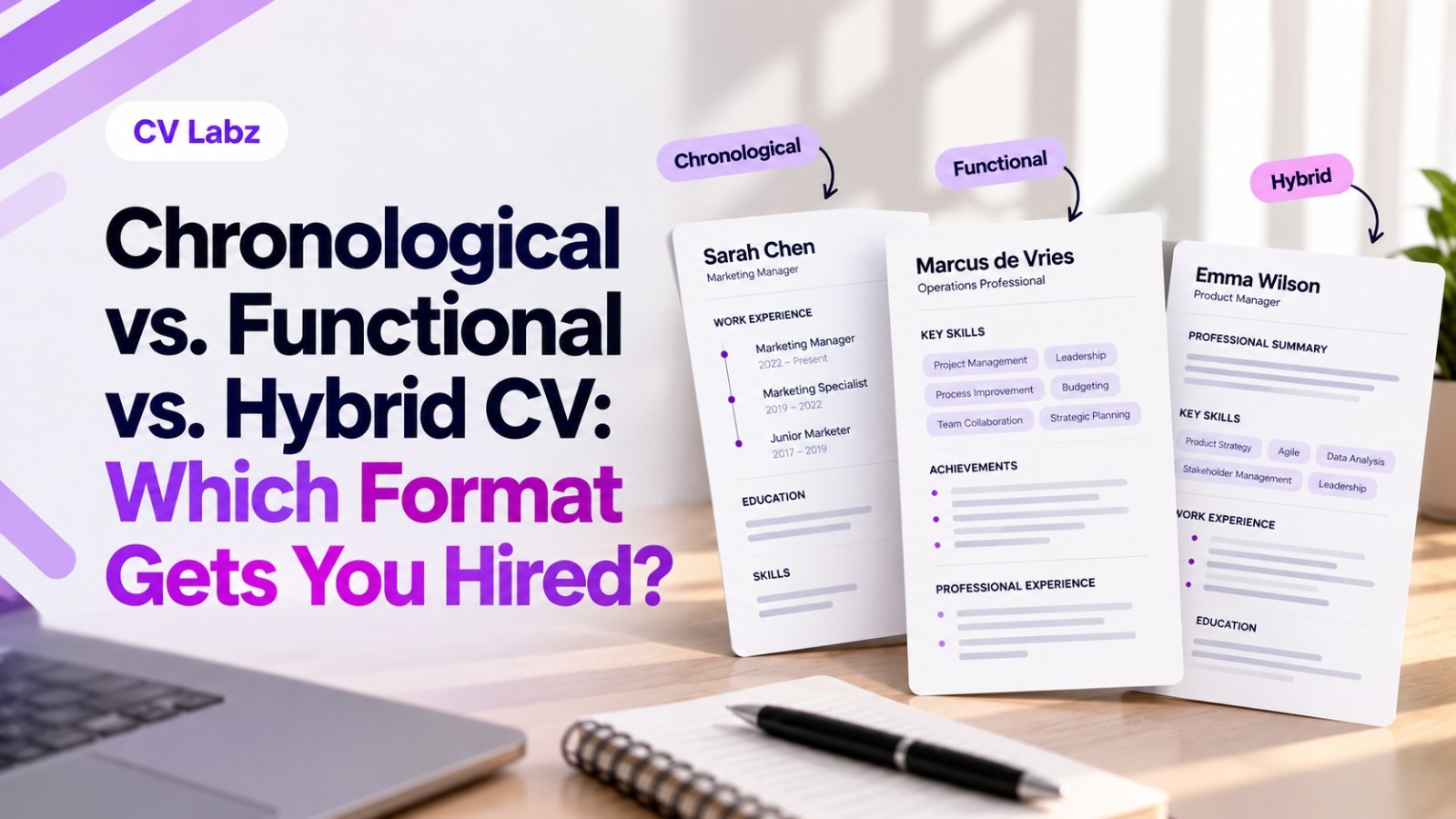
Your CV format affects how quickly a recruiter understands your experience. The same qualifications look different depending on how they are organized.
The three formats most candidates consider are the chronological resume, functional resume, and hybrid resume. Each one presents your experience differently and suits different career situations.
At CV Labz, the CV Builder helps you create a professional CV with structured templates, letting you focus on presenting your experience clearly instead of spending time fixing the layout.
The right format isn't about choosing the most attractive design. It's about choosing the structure that makes your strongest qualifications easy to find.
What Makes a CV Format Effective?
A good CV format should make your career story easy to understand.Recruiters need to find your most relevant experience, skills, and achievements without searching through unnecessary information. The structure should guide their attention toward the details that matter for the role.
Your strongest qualifications should also remain visible. If an important skill or achievement is buried under lengthy descriptions, it loses its impact.
The format also needs to work for Applicant Tracking Systems (ATS). Clear sections, standard headings, and a simple structure make your information easier to process.
Think of the format as the framework of your CV. The content tells recruiters what you have achieved. The structure determines how easily they see it.
What Is a Chronological Resume?
A chronological resume presents your employment history as a career timeline. Most candidates use the reverse chronological approach, starting with their most recent position and moving backward through previous roles.
This gives recruiters an immediate view of your current role, previous positions, and career progression.
- Professional Summary
- Work Experience
- Most recent role
- Previous role
- Earlier role
- Education
- Skills
- Certifications
The structure is familiar to recruiters and makes your career history easy to follow.
Strengths of a Chronological Resume
The biggest advantage is clarity.Recruiters quickly see where you work, how long you've worked in each role, and how your responsibilities have developed.
A chronological resume works particularly well for candidates with:
- A consistent employment history.
- Relevant experience in the same industry.
- Clear career progression.
- Recent achievements related to the target position.
For example, a Marketing Manager applying for another Marketing Manager position has a straightforward career story. Their recent roles, responsibilities, and achievements directly support the position they're targeting.
A chronological resume template makes this progression easy to present while keeping the layout professional and straightforward.
Who Should Use a Chronological Resume?
This format is a strong choice for experienced professionals whose recent work matches their career goals.
It also suits candidates who have moved upward through similar roles and want recruiters to notice that progression immediately.
If your employment history is one of your strongest selling points, putting it at the centre of the CV makes sense.
What Is a Functional Resume?
So, what is a functional resume? A functional resume puts greater emphasis on skills, capabilities, and relevant achievements instead of making employment history the main focus.
Rather than giving every position equal attention, the CV groups relevant abilities into sections such as:
- Project Management
- Customer Service
- Digital Marketing
- Leadership
- Technical Skills
Each section then provides evidence of those abilities through relevant experience or achievements.This approach answers a different question:
What does this candidate bring to the role? That makes the functional resume particularly useful when a candidate's skills tell a stronger story than their job titles.
Strengths of a Functional Resume
The biggest benefit is flexibility. It gives you space to bring transferable skills to the front, which is useful when your previous job titles don't directly match the position you're targeting.
For example, someone moving from hospitality management into operations highlights:
- Team leadership
- Staff scheduling
- Budget management
- Customer service
- Process improvement
These skills are highly relevant to an operations position even though the candidate's previous industry was different.
Who Should Use a Functional Resume?
A functional resume suits candidates whose strongest qualifications come from their skills and transferable experience.
It suits:
- Career changers.
- Candidates returning to work.
- Professionals with varied experience.
- People with relevant freelance or project-based experience.
- Candidates moving into a role where transferable skills matter more than previous job titles.
However, your employment history should still be clear. A functional format should highlight your strengths without leaving recruiters wondering where your experience came from.
What Is a Hybrid Resume?
A hybrid resume combines the strongest elements of chronological and functional formats.
It gives your skills and achievements prominent space while still presenting your employment history in reverse chronological order.
A typical structure looks like this :
- Professional Summary
- Core Skills
- Key Achievements
- Work Experience
- Most recent role
- Previous role
- Earlier role
- Education
- Certifications
This gives recruiters two things at once: a quick view of your strongest abilities and a clear understanding of your career history.
Strengths of a Hybrid Resume
The main advantage is balance. A hybrid resume gives you room to highlight transferable skills without removing the career timeline recruiters expect to see.
For example, a professional moving from traditional marketing into digital marketing highlights SEO, content strategy, analytics, and campaign management near the top. Their employment history then provides context for where those skills were developed.
Who Should Use a Hybrid Resume?
A hybrid format is useful for candidates who don't fit neatly into one category.
It works particularly well for:
- Career changers with substantial experience.
- Professionals moving into a new industry.
- Candidates with strong transferable skills.
- Experienced professionals who want to highlight specific expertise.
- Candidates whose skills and career progression are equally important.
A hybrid resume template gives these candidates more flexibility without making their work history difficult to follow.
Chronological vs. Functional vs. Hybrid: Which One Is Better?
There isn't one format that wins for every candidate.
The better choice depends on what you need recruiters to notice first.
| What matters | Chronological | Functional | Hybrid |
| Career progression | Excellent | Limited | Strong |
| Skills emphasis | Moderate | Strong | Strong |
| Career gaps | More visible | Less prominent | Moderate |
| Career changers | Less suitable | Strong | Strong |
| Recruiter familiarity | High | Lower | High |
| ATS simplicity | Strong | Depends on structure | Strong |
| Best for | Steady careers | Skill-focused careers | Mixed situations |
The chronological resume puts your career history first. It works well when your recent roles directly support the position you're targeting.
The functional resume puts your capabilities first. It suits candidates who need to bring transferable skills forward.
The hybrid resume sits between the two. It highlights skills while keeping your employment history visible.
So the question isn't simply which format is "best."The better question is: Which format makes my strongest qualifications easiest for a recruiter to understand?
Which CV Format Should You Choose?
Choosing your format becomes easier when you look at your career story. Your CV should also be tailored to the requirements of the role you're applying for. Learn how to identify and fix gaps between your CV and a job description to highlight relevant skills, experience, and keywords.
Choose Chronological If Your Experience Tells the Strongest Story
Use a chronological structure when your recent positions are relevant, your career progression is clear, and your employment history supports the role you're targeting.
This format lets recruiters see your professional development without having to piece together your background.
Choose Functional If Your Skills Matter More Than Your Timeline
A functional structure makes more sense when you're changing careers, returning to work, or bringing transferable skills from different types of experience. It allows you to show what you contribute before recruiters focus on where you worked.
Choose Hybrid If You Need Both Skills and Experience to Stand Out
Choose a hybrid structure when your skills need more attention but your employment history still adds important context.
This approach works well when you're moving into a new industry but already have substantial professional experience.
Which Format Works Best for ATS?
ATS software doesn't automatically choose one resume format simply because it is chronological, functional, or hybrid.What matters more is how clearly the information is structured.
Use:
- Standard section headings.
- Clear job titles.
- Consistent employment dates.
- Relevant keywords.
- Simple formatting.
- Readable fonts and spacing.
Avoid complicated layouts with excessive graphics, text boxes, tables, or decorative elements.
A clean chronological resume template provides a straightforward structure that both recruiters and ATS software process easily.
At CV Labz, the CV Builder provides professionally structured templates that help you organize your experience without struggling with formatting from scratch.
Build Your CV Around What Makes You a Strong Candidate
The best CV format isn't determined by a universal rule.A chronological resume works when your career progression is your strongest asset. A functional resume puts your transferable skills at the center. A hybrid resume gives you room to showcase both skills and experience.Your job is to choose the structure that makes your most relevant qualifications obvious within seconds.
CV Labz's CV Builder helps you create a professional CV with structured templates, letting you focus on your experience, achievements, and career goals instead of struggling with formatting. Choose a format that tells your career story clearly and put your strongest qualifications where recruiters will see them.
FAQs
1. Is a chronological resume better than a functional resume?
Neither format is automatically better. A chronological resume suits candidates with clear and relevant career progression, while a functional resume gives greater emphasis to skills and transferable experience.
2. What is a functional resume and who should use it?
A functional resume focuses on skills and achievements rather than making the employment timeline the main feature. It suits candidates such as career changers and professionals with varied experience.
3. Is a hybrid resume better for career changers?
A hybrid resume is useful for career changers who have substantial experience and need to highlight transferable skills while still showing a clear employment history.
4. What is the most preferred resume format?
The chronological format is familiar to most recruiters and works well for candidates with consistent, relevant career progression. However, the most suitable format depends on the candidate's career history.
5. Which CV format is best for ATS?
ATS systems focus on readable, structured information rather than simply preferring one format. Clear headings, standard formatting, relevant keywords, and an easy-to-follow work history are important.