How to Explain a Career Break on Your Resume
Learn how to explain a career break on your resume with clear, professional examples. Discover how to address employment gaps caused by family responsibilities, education, relocation, personal circumstances, or job searches while highlighting relevant skills and professional development. CV Labz helps you create a polished resume that presents your career history with clarity and confidence.
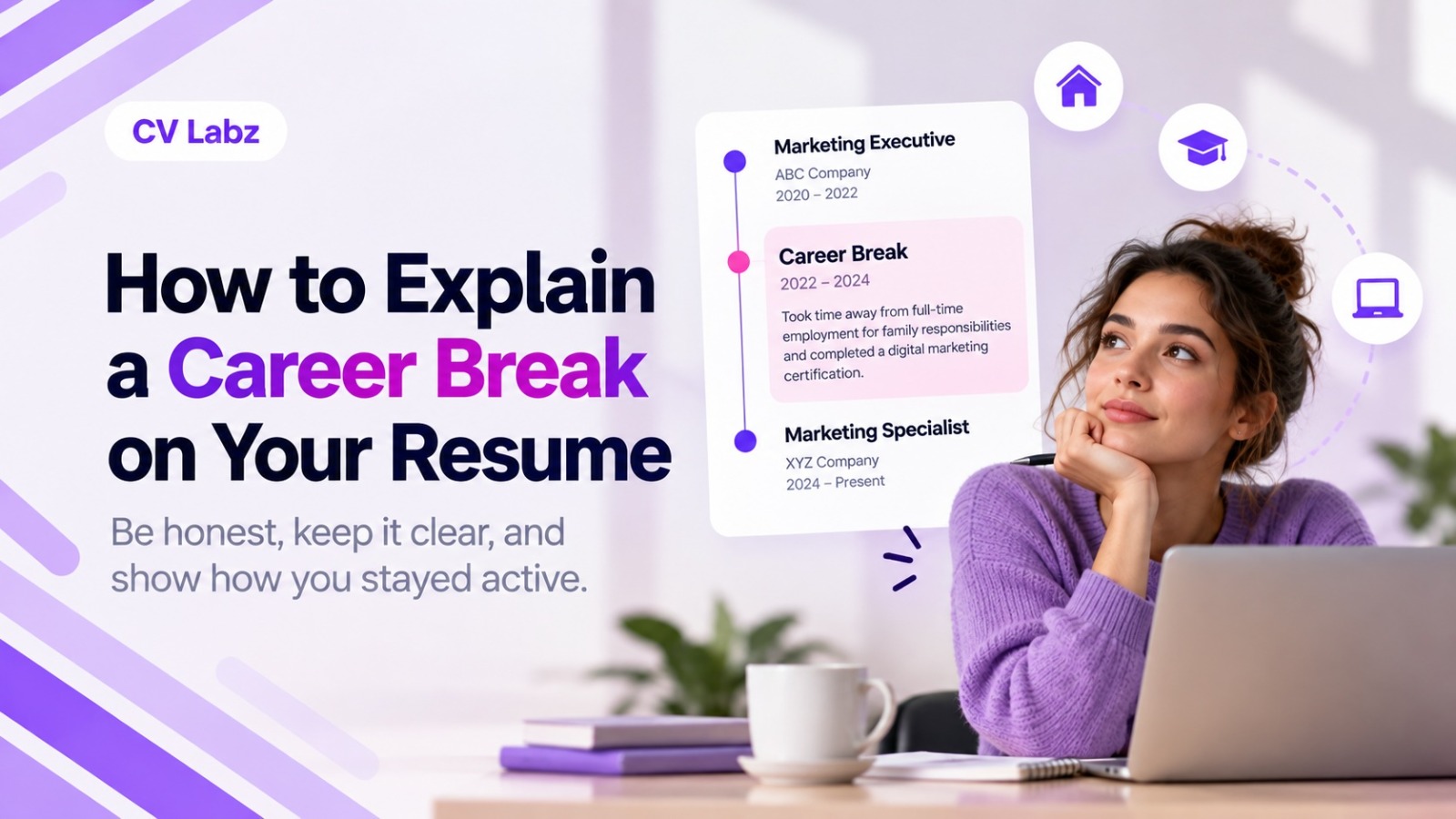
A career break does not automatically make your resume weaker. People step away from work for many reasons, including family responsibilities, education, relocation, or personal circumstances.
The problem starts when a noticeable gap is left unexplained. Recruiters see the dates but have no context for what happened during that period.
The goal is not to hide your career break. It is to present it clearly, briefly and professionally while keeping the focus on the experience and skills you bring to your next role.
At CV Labz, you use the CV Builder to create a professional resume that presents your career history in a clear and organized structure.
Why You Should Mention a Career Break
A long gap in your employment history leaves questions for recruiters. If your resume
moves from one job to another with a significant period missing, the timeline becomes
unclear. Adding a simple career-break entry gives that period context.
For example:
Career Break | 2022–2024
Taken time away from full-time employment to manage family responsibilities and
maintain professional knowledge through relevant courses. This tells the recruiter what happened without turning your resume into a personal
explanation.
You also don't need to share private details. The purpose is to make your timeline understandable and then move the focus back to your professional qualifications. An unexplained gap in resume history distracts from otherwise strong experience. A clear explanation helps the recruiter understand the timeline and continue evaluating your application based on your skills and achievements.
What Counts as a Career Break?
A career break is a period when you intentionally step away from regular employment. The reason and length vary from one candidate to another.
Common examples include:
- Family or caregiving responsibilities
- Further education
- Professional development
- Relocation
- Personal circumstances
- Health-related situations
- Layoffs
- Extended job searches
- Career exploration
Not every short period between jobs needs to be labeled as a career break. The more noticeable the gap, the more useful it becomes to provide some context.
What matters most is keeping your employment dates accurate and explaining the period in a way that is relevant to your professional story.
How to Show a Career Break
Once you've decided that the gap needs context, the next step is presenting it properly.
You don't need to create an elaborate section or write a long explanation. A simple entry within your employment timeline is enough.
1. Add a Career Break Entry
Include the career break between the relevant jobs so the timeline remains easy to
follow.
For example:
Marketing Executive | ABC Company | 2020–2022
Managed digital campaigns, developed content strategies, and monitored campaign
performance.
Career Break | 2022–2024
Took time away from full-time employment for family responsibilities while completing
relevant professional development.
Marketing Specialist | XYZ Company | 2024–Present
Manage digital marketing campaigns and develop content strategies for multiple
clients.
This approach makes the dates clear. The recruiter doesn't have to guess what
happened between your two positions.
2. Keep the Explanation Brief
Your resume is not the place for a detailed personal story.
A short explanation is enough to establish context. Focus on the reason for the break
only to the extent that it helps explain your timeline.
Instead of writing several sentences about what happened, use a direct statement.
Career Break | 2021–2023
Taken time away from full-time employment for family responsibilities and am now
ready to return to the workforce.
Simple. Clear. Professional.
3. Include Relevant Activities
If you used your career break to develop skills or stay professionally active, include
those activities when they are relevant.
Mention:
● Professional courses
● Certifications
● Freelance projects
● Volunteering
● Personal projects
● Industry training
● Relevant independent work
For example:
Career Break | 2021–2023
Taken time away from full-time employment for family responsibilities and completed a
digital marketing certification.
The purpose isn't to make the break look like employment. It is to show relevant
development that genuinely took place during that period.
4. Focus on Your Return
After explaining the break, bring the attention back to your professional value.
Your recent experience, relevant skills, achievements and qualifications should receive more attention than the gap itself.
The career break explains one part of your timeline. It shouldn't become the main story of your resume.
How to Explain Different Career Gaps
The reason behind a career break affects how much context you need to provide. You
don't need to use the same explanation for every situation.
The goal is to keep the wording professional and avoid sharing information that isn't
relevant to your application.
5. Family or Care giving Responsibilities
Family responsibilities are a valid reason for stepping away from full-time work. You
don't need to explain private family circumstances in detail.
For example:
Career Break | 2022–2024
Taken time away from full-time employment to manage family responsibilities, and am
now ready to return to full-time work.
If you completed relevant courses or maintained your professional skills during this
period, mention that as well.
6. Education or Up skilling
Present a career break spent learning new skills or completing qualifications as part of your professional development.
For example:
Career Break | 2021–2023
Completed professional training in data analytics and developed practical skills through independent projects.
Choose learning that supports the type of role you're applying for. There's no need to list unrelated courses simply to make the gap look busy.
7. Relocation
Moving to a new city or country effects your employment timeline.
Keep the explanation simple:
Career Break | 2022–2023
Relocated to Dubai and focused on establishing a new professional base before
returning to full-time employment.
You don't need to describe every detail of the move. A short explanation is enough to
make the timeline clear.
8. Personal or Health Reasons
You don't have to disclose sensitive personal or medical information on your resume.
If you need to provide context, keep it professional:
Career Break | 2021–2023
Taken a planned career break for personal reasons and am now ready to return to full-time employment.
The focus should quickly move back to your current skills, qualifications, and readiness for the role.
9. Layoff or Job Search
If your career break followed a layoff or an extended job search, keep your employment dates accurate.
Include genuine activities you completed during that period, such as:
● Freelance projects
● Professional courses
● Certifications
● Volunteering
● Industry events
● Relevant personal projects
Don't describe job searching as employment. Instead, show any real professional
activity that helped you stay engaged or develop relevant skills.
How Freshers Should Explain Gaps
For freshers, a gap appears before their first full-time role rather than between two jobs.
That makes the explanation slightly different.
You don't need to make the gap sound like employment. Instead, explain what you were doing during that period and highlight anything that helped you prepare for your career.
Common reasons include:
● Exam preparation
● Further education
● Skill development
● Personal responsibilities
● Career exploration
● Preparing for your first professional opportunity
Focus on What You Did During the Gap
If you completed courses, worked on projects, or developed relevant skills, include those details where they support your target role.
For example:
Career Preparation | 2023–2024
Completed professional courses in digital marketing and developed practical skills
through independent projects before beginning my job search.
This gives the recruiter context while showing that you used the period for genuine
development.
The key is to remain honest. You don't need to create a complicated explanation for a
gap. A simple statement supported by relevant activities is enough.
Sample Resume With Gaps in Employment
Seeing a career break written into a resume is easier when you have a clear example to follow. The goal is to keep the employment timeline honest while giving the gap enough context.
Here is a simple example:
Marketing Executive | ABC Company | 2020–2022
Managed digital campaigns, developed marketing content, and monitored campaign
performance.
Career Break | 2022–2024
Taken time away from full-time employment for family responsibilities while completing relevant professional development.
Marketing Specialist | XYZ Company | 2024–Present
Manage digital campaigns, develop content strategies, and track performance across
multiple channels.
This format works because the timeline remains clear. The career break is neither
hidden nor given more attention than the actual work experience.
If you completed relevant training, freelance work, or projects during the break, include them under the career-break entry. Only mention activities that genuinely took place during that period.
For example:
Career Break | 2022–2024
Taken time away from full-time employment for family responsibilities. Completed a
digital marketing certification and worked on independent content projects.
The right approach depends on what you actually did during the break. There is no need to make the period look more productive than it was.
Make Your Career Break Part of Your Story
A career break is one part of your professional timeline. It doesn't need to define your
resume.
The best approach is straightforward. Show the dates clearly, provide a brief
explanation, and mention relevant developments when it genuinely applies. Then bring the reader's attention back to your skills, experience, and achievements.
You don't need to hide a career break, but you also don't need to explain every personal detail behind it.
A professional resume gives recruiters enough context to understand the timeline and enough relevant information to evaluate what you bring to the role.
If you're ready to create a polished resume, use the CV Labz CV Builder to organize your experience, career break, skills, and achievements into a clear professional structure.
FAQs
1. Should I mention a career gap in my resume?
Yes, if the gap is long or noticeable enough to raise questions about your employment
timeline. A short, professional explanation provides context without going into
unnecessary personal details.
2. How do I mention a career break in my resume?
Add a simple entry within your employment timeline. Include the dates and a brief
explanation of the reason for the break. If you completed relevant courses, projects, or
training, mention them when appropriate.
3. How should I show a career break on my resume?
Use a clear entry, such as Career Break | 2022–2024, followed by one or two lines
explaining the period. Keep the dates accurate and make sure the rest of your resume
remains focused on your professional experience.
4. How do I explain a career break due to family reasons?
Keep the explanation brief and professional. For example:
Career Break | 2022–2024
Took time away from full-time employment to manage family responsibilities, and am
now ready to return to full-time work. You don't need to include private family details.
5. What are good reasons for gaps in employment for freshers?
Common reasons include further education, exam preparation, skill development,
personal responsibilities, or preparing for a first professional opportunity. The important thing is to explain the situation honestly rather than inventing a reason.
6. How do I explain a long gap in my resume?
Use a clear career-break entry with the relevant dates and a concise explanation. If you developed skills, completed training, worked on projects, or did other relevant activities during the period, include them where they support your target role.