Keyword Stuffing vs. Natural Matching: Who Can Optimize Your Resume?
Repeating ATS keywords doesn’t make your resume stronger. Natural keyword matching does. Use terms from the job description in context to describe your real skills and achievements, place them in your summary, experience, and skills sections, and keep your resume clear, accurate, and readable.
Adding ATS keywords to your resume helps employers identify relevant skills and experience, but repeating the same terms does not make your application stronger. The better approach is natural keyword matching, where you use relevant terms from a job description to describe your actual qualifications and achievements.
Applicant tracking systems (ATS) help employers manage applications and, depending on the system and employer's setup, organize or filter candidates. A resume filled with repeated phrases might look optimized at first, but it offers little value when those phrases lack context. Effective resume keyword optimization balances relevant terminology, clear writing, and evidence of your abilities.
At CV Labz, our CV Builder helps you create a professional CV with a clear structure, making it easier to present your relevant skills and experience. Understanding how to use keywords naturally helps you make that content more relevant to the roles you want.
What Are ATS Keywords and Why Do They Matter?
ATS keywords are words and phrases related to a job's responsibilities, qualifications, skills, and industry. Employers include these terms in job descriptions to explain what they expect from candidates.
For example, a digital marketing position might mention SEO, Google Analytics, content strategy, campaign management, and conversion tracking. If you have experience in these areas, including the relevant terms in your resume helps communicate your qualifications clearly.
What Counts as an ATS Keyword?
Common categories of ATS resume keywords include:
- Job titles: Marketing Manager, Project Coordinator, Software Developer.
- Technical skills: SEO, data analysis, financial modelling.
- Software and tools: Microsoft Excel, Salesforce, Jira.
- Certifications: Relevant professional or technical credentials.
- Industry terminology: Terms specific to your profession.
- Professional skills: Communication, leadership, project management.
The right keywords depend on the job description and your experience. Your goal is to demonstrate a genuine match, not include every term you find.
What Is Keyword Stuffing on a Resume?
Keyword stuffing means repeating keywords excessively or adding unrelated terms to make a resume appear more relevant to an applicant tracking system.
For example, a candidate applying for a project management role might list “project management” six times in a short skills section without explaining any relevant experience. Another candidate might add software names they have never used because those tools appear in the job description.
Neither approach demonstrates professional competence.
Why Keyword Stuffing Hurts Your Resume
Keyword stuffing creates several problems:
- Poor readability: Repetitive language makes your resume harder to scan.
- Weak evidence: Listing skills without examples does not demonstrate how you used them.
- Reduced credibility: Unfamiliar tools or unsupported qualifications raise questions about accuracy.
- Irrelevant content: Unrelated keywords distract from your actual strengths.
There is no universal keyword count that guarantees ATS success. Employers use different systems and screening settings, so relevance and accuracy matter more than repetition.
What Is Natural Resume Keyword Matching?
Natural matching means incorporating relevant job-description terms into your resume where they accurately describe your skills, experience, and achievements.
Effective resume keyword optimization places keywords in context rather than treating them as a checklist. You might include relevant terms in your professional summary, work experience, skills section, projects, and certifications.
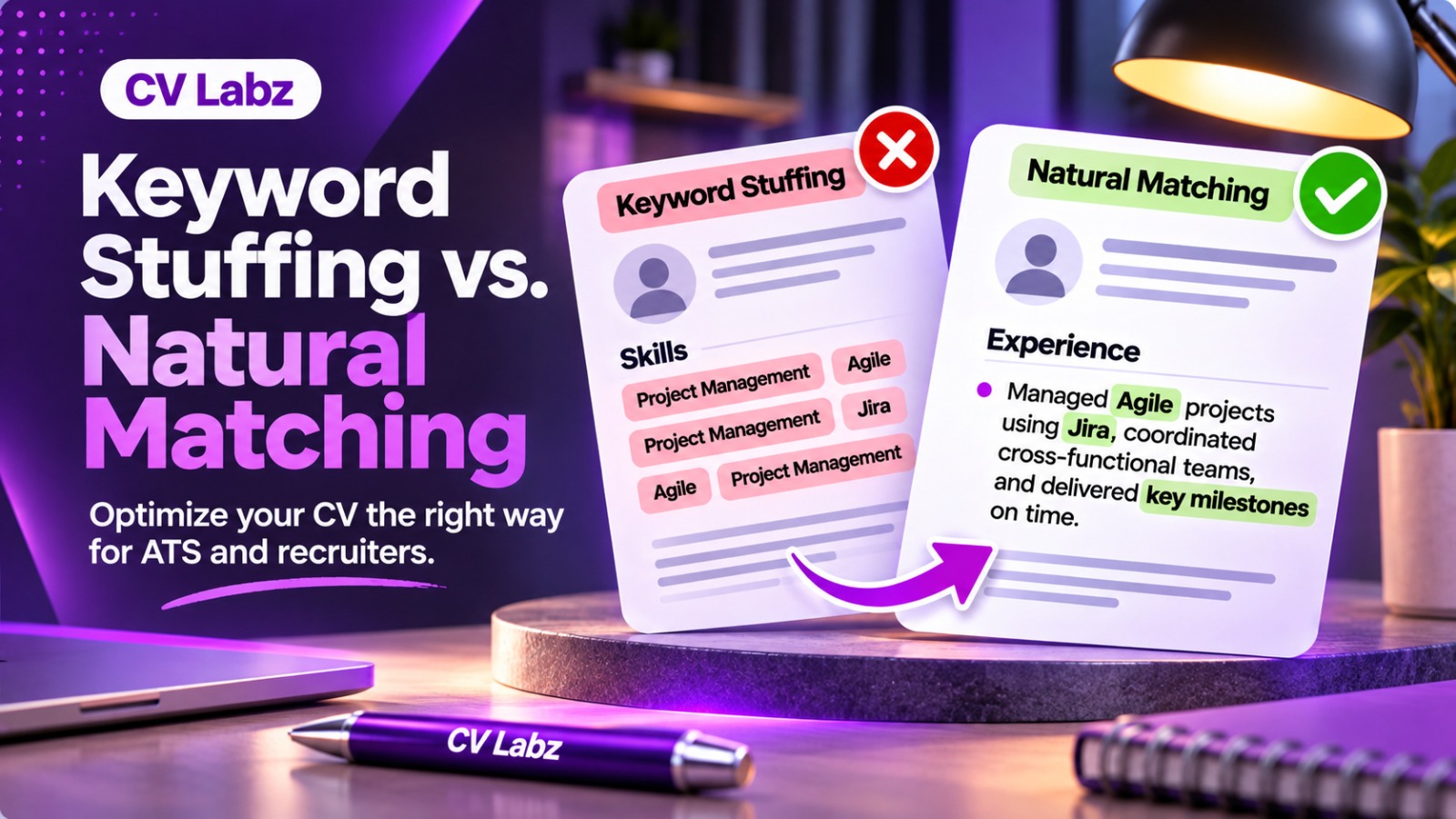
Example: Keyword Stuffing vs. Natural Matching
Keyword-stuffed version:
Project Management, Agile, Jira, Project Management, Team Management, Agile, Project Management.
Naturally optimized version:
Managed Agile software projects using Jira, coordinated cross-functional teams, and tracked project milestones to support timely delivery.
The second version includes relevant terminology while explaining how the candidate applied those skills. It gives recruiters meaningful information instead of an isolated list of repeated phrases.
Keyword Stuffing vs. Natural Matching: What Is the Difference?
| Keyword Stuffing | Natural Matching | |
| Repeats terms unnecessarily | Uses relevant terms in context | |
| Focuses on keyword quantity | Focuses on job relevance | |
| Makes sentences sound robotic | Keeps writing clear and professional | |
| Includes unsupported or unrelated terms | Reflects genuine qualifications | |
| Lists skills without evidence | Connects skills to responsibilities and results | |
| Prioritizes repetition | Balances ATS relevance and readability |
Natural matching is the stronger approach because it communicates relevant qualifications to screening systems while giving recruiters a clear understanding of your experience.
How Do You Find the Right ATS Resume Keywords?
Start with the job description instead of a generic keyword list. This keeps your resume focused on the employer's actual requirements.
1. Identify Important Terms in the Job Description
Look for required skills, recurring responsibilities, software, certifications, qualifications, and industry terminology.
For example, a customer success role might emphasize client relationship management, onboarding, customer retention, and CRM software. These terms provide a useful starting point when they match your background.
2. Separate Required and Preferred Skills
Prioritize mandatory qualifications and essential skills first. Then review preferred qualifications that match your experience.
Do not add a certification, tool, or skill you lack simply because the employer mentions it. Accurate representation protects your credibility and prepares you for interview questions.
3. Match the Employer's Language When Appropriate
If the job description uses “customer relationship management,” include that phrase when it accurately describes your experience. If you have used Salesforce, mention the platform by name as well.
This approach makes your qualifications easier to understand without forcing unnecessary variations of the same keyword.
Where Should You Use Resume Keywords?
The placement of resume keywords matters because each section communicates a different part of your professional background.
1. Professional Summary
Use a few relevant terms to introduce your expertise and target role.
For example:
Digital marketing professional with experience in SEO, content strategy, keyword research, and performance reporting.
2. Work Experience
Show how you applied your skills in previous roles. Whenever possible, connect responsibilities with outcomes or measurable achievements.
3. Skills Section
List relevant technical and professional skills in a clear, easy-to-scan format. Remove unrelated skills that do not support your target position.
4. Projects and Certifications
Include specialized tools, methods, and qualifications when they genuinely apply. This section is particularly useful for recent graduates and career changers who need to demonstrate relevant knowledge beyond their employment history.
How Many ATS Keywords Should a Resume Have?
There is no fixed number of ATS keywords that works for every resume. The appropriate number depends on the role, the job description, your experience, and the skills required.
Instead of aiming for a specific count, identify the most relevant requirements and incorporate them naturally throughout your resume.
A technical role might require several software names and specialized terms, while an administrative position might emphasize scheduling, documentation, communication, and office software. Each resume needs a different keyword mix.
The goal is not to maximize repetition. It is to show a clear match between the employer's requirements and your qualifications.
What Does Effective Resume Optimization Include Beyond Keywords?
Strong resume optimization involves more than matching phrases from a job description. Your resume also needs a clear structure, relevant content, and evidence of your abilities.
Focus on these areas:
- Formatting: Use clear headings and consistent spacing.
- Relevance: Prioritize experience related to the target role.
- Achievements: Explain what you accomplished rather than listing duties alone.
- Accuracy: Keep job titles, dates, qualifications, and skills truthful.
- Readability: Write concise bullet points and avoid unnecessary jargon.
- Consistency: Use standard section headings and a straightforward layout.
For example, listing “SEO, content marketing, Google Analytics” identifies skills. Writing “Improved organic search performance through SEO-focused content planning and Google Analytics reporting” provides context.
That distinction makes your resume more informative to recruiters
Who Should Optimize Your Resume for ATS Keywords?
A resume-building tool helps you organize your qualifications into a clear, professional structure. At CV Labz, our CV Builder helps you present your skills and experience in an organized format. You remain responsible for ensuring that the content accurately reflects the job requirements and your background.
Build a Resume That Matches Without Stuffing
A strong resume does not need repeated keywords to demonstrate relevance. It needs accurate terminology, clear evidence, and a structure that makes your qualifications easy to understand.
At CV Labz, our CV Builder helps you create a professional CV with a clear structure, making it easier to present your relevant skills and experience. Use it to organize your background, then review each section against your target job description.
The aim is simple: match the job requirements naturally, demonstrate your abilities honestly, and make every line count.
FAQs
Q.1 What Are ATS Keywords?
ATS keywords are terms related to a job's required skills, qualifications, responsibilities, and industry. Employers use applicant tracking systems to manage applications, and some screening processes use these terms to help identify relevant candidates.
Q.2 How Do I Find ATS Resume Keywords?
Review the job description for required skills, software, qualifications, and recurring terminology. Include the terms that accurately reflect your experience and qualifications.
Q.3 Is Keyword Stuffing Bad for ATS?
Keyword stuffing is a poor resume strategy because it creates repetitive, unnatural content and offers little evidence of your abilities. Relevant keywords used in context provide a stronger presentation.
Q.4 How Many Keywords Should I Put on My Resume?
There is no universal number. Choose keywords according to the target job, its requirements, and your experience rather than aiming for an arbitrary count.
Q.5 What Is the Best Keyword for a Resume?
The best keyword for resume optimization depends on the role. Prioritize relevant job titles, required skills, tools, certifications, and industry terms that accurately describe your qualifications.
Q.6 Does Resume Keyword Optimization Work?
Effective resume keyword optimization helps communicate your relevance to a position. However, keywords alone do not guarantee that an ATS will rank your application highly or that an employer will invite you to interview.
Q.7 How Do I Optimize My Resume Without Keyword Stuffing?
Identify the job's essential requirements, use matching terms naturally in relevant sections, connect skills to real achievements, and remove unnecessary repetition. Review the finished resume for both relevance and readability.