The Resume-to-Job-Description Match Test (And What Your Score Actually Means)
Learn how resume-to-job-description matching works and what your resume match score really means. Discover how ATS systems evaluate resumes, what makes a good match score, and practical ways to improve your resume by tailoring your skills, keywords, summary, and achievements to each job
Landing an interview starts long before a recruiter reads your resume. Today, many companies compare your resume with the job description before deciding whether your application should move forward. If your resume doesn't reflect what the employer is looking for, it becomes harder to stand out.
At CV Labz, we help job seekers create resumes that align with today's hiring process and make stronger first impressions. Understanding how resume matching works is an important step toward submitting more relevant applications.
In this guide, we'll explain what job description and resume match means, what your resume match score actually tells you, and how to improve it before applying for your next role.
What Is a Resume-to-Job-Description Match?
A job description and resume match measures how closely your resume aligns with the requirements of a specific job posting. When an employer advertises a role, they usually list the skills, qualifications, experience, and responsibilities they expect from the ideal candidate. Your resume is then compared against those requirements to determine how relevant your background is.
This comparison shows employers which applicants experience closely matches the role they're hiring for. Many companies use an Applicant Tracking System (ATS) as the first step in this process. The system scans resumes for relevant keywords, job titles, skills, and other information before passing suitable applications to a recruiter.
What Does Your Resume Match Score Actually Mean?
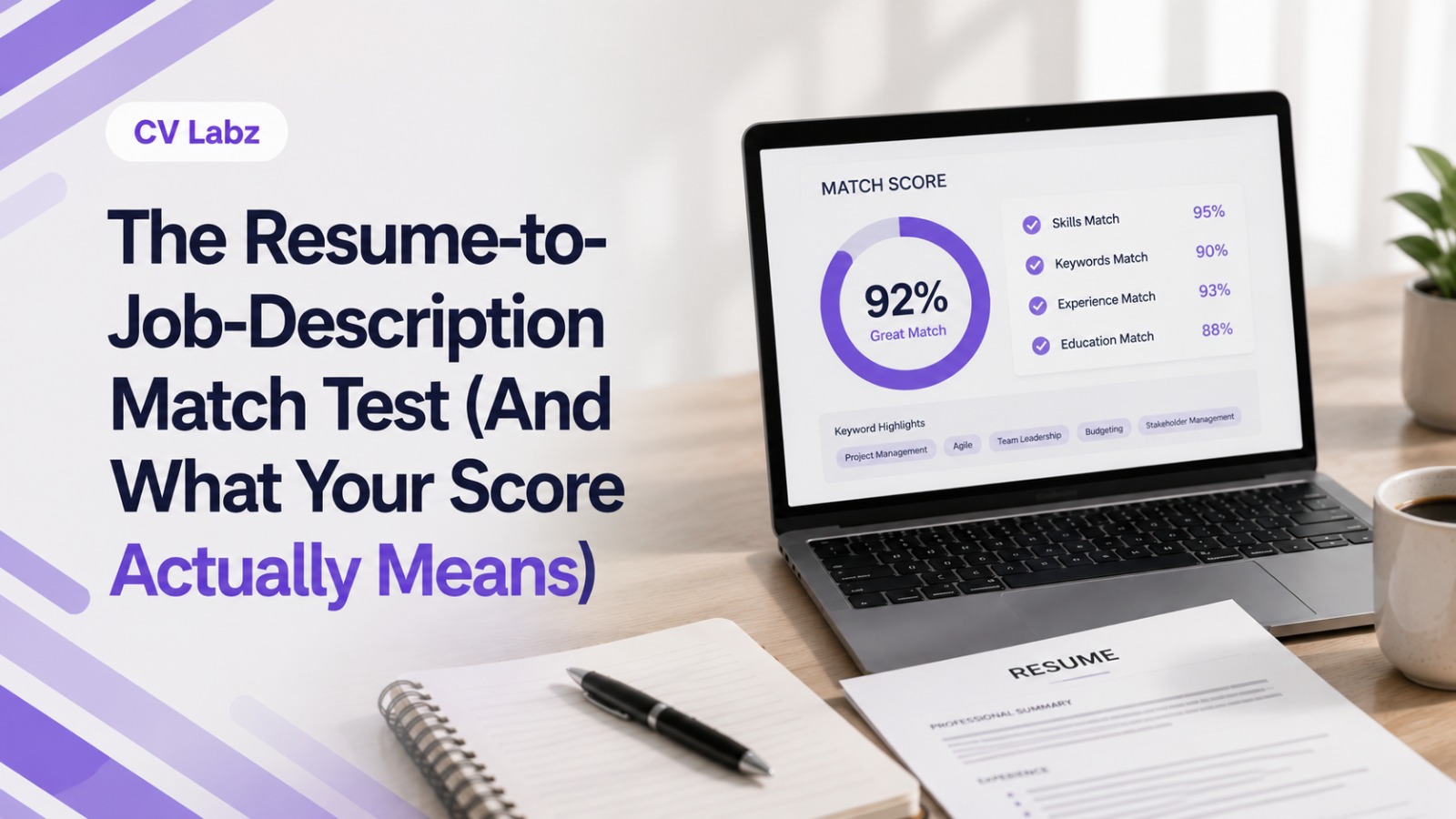
A resume match score is an estimate of how well your resume matches a particular job description. Different resume matching tools use different scoring methods, but the goal is the same. They compare your resume with the employer's requirements and identify how closely the two align.
A higher score generally means your resume reflects more of the qualifications the employer is looking for. However, the score is only a guide. It shows you where your resume is already strong and where it needs improvement before you apply.
How Resume Match Scores Are Calculated
Your score is based on several factors that employers commonly look for.
These usually include:
- Relevant skills.
- Keywords used throughout the job description.
- Previous work experience.
- Job titles.
- Education and certifications.
For example, imagine a company is hiring a Digital Marketing Specialist.
The job description repeatedly mentions SEO, Google Analytics, content strategy, and email marketing.
If your resume highlights experience in those areas, your score is likely to be higher because your background closely matches the role.
On the other hand, if your experience is relevant but described using completely different language, the match score drops even though you have the right qualifications.
That's why tailoring your resume for each application makes such a noticeable difference.
What Is Considered a Good Resume Match Score?
There isn't one perfect number. Instead, think of your score as a way to measure how closely your resume matches the employer's expectations.
As a general guide:
- 90–100% – Your resume closely aligns with the job description and highlights most of the employer's key requirements.
- 80–89% – A strong match. Small improvements or additional relevant details strengthen your application even further.
- 70–79% – A reasonable match, but there are important skills, keywords, or achievements that should be reviewed before applying.
- Below 70% – Your resume doesnt clearly demonstrate why you're the right fit for the role. Updating your resume to better reflect the job description improves the match.
It's also important to remember that a high score doesn't automatically guarantee an interview.
Recruiters still evaluate the quality of your experience, career progression, achievements, and overall suitability for the position.
Think of your resume match score as the starting point, not the final decision.
How to Improve Your Resume Match Score
Improving your resume and job description match doesn't mean changing your experience. It means presenting your experience in a way that reflects what the employer is looking for.
A few thoughtful updates before submitting your application make your resume more relevant and easier for recruiters to review.
1. Start With the Job Description
Before editing your resume, read the job description from beginning to end. Pay attention to the skills, qualifications, tools, and responsibilities that appear more than once. Employers usually repeat the requirements they consider most important. These details give you a clear idea of what should stand out in your resume.
2. Match Your Existing Experience
Once you've identified the employer's priorities, compare them with your own experience.If you've used the same tools, managed similar responsibilities, or developed the required skills, make sure they're clearly reflected in your resume.Use language that naturally matches the job description, but only when it accurately represents your experience. The goal is to improve clarity, not rewrite your career history.
3. Update Your Professional Summary
Your professional summary is one of the first sections recruiters read.Instead of using the same summary for every application, tailor it to the role you're applying for. Highlight your most relevant experience, key strengths, and the value you bring to that specific position. A targeted summary immediately shows employers that your background aligns with their requirements.
4. Highlight Relevant Achievements
Not every achievement deserves the same level of attention.For each application, prioritize accomplishments that relate directly to the role. For example, if you're applying for a sales position, achievements related to revenue growth or client acquisition should appear before less relevant accomplishments. This shows recruiters your strongest qualifications without making them search through your entire resume.
5. Keep Your Resume Clear and ATS-Friendly
Good formatting supports good content. Use clear section headings, consistent fonts, and simple layouts that are easy to scan. Avoid graphics, text boxes, and unnecessary design elements that make your resume difficult to read.
A clean structure improves readability for both recruiters and Applicant Tracking Systems. At CV Labz, our Resume Matcher compares your resume with a job description, identifies areas for improvement, and creates a stronger application before you apply.
Why Two Candidates Can Get Different Match Scores
Imagine two candidates applying for the same marketing role. Both have similar years of experience. Both have worked on successful campaigns. Both meet the basic qualifications. Yet one receives a much higher resume match score than the other.
The difference usually isn't experience. It's how that experience is presented. The first candidate submits the same resume they've used for every application. Their skills and achievements are relevant, but they're buried among information that has little connection to the role.
The second candidate spends a few minutes reviewing the job description before applying. They update their professional summary, highlight their most relevant achievements, and use language that reflects the employer's requirements without exaggerating their experience.
Both candidates have similar backgrounds. One simply makes it easier for recruiters and hiring systems to recognize that they're a good fit. That's why tailoring your resume isn't about starting from scratch every time. It's about making sure the most relevant parts of your experience are the easiest to find.
What Recruiters Look Beyond the Match Score
A strong resume match score makes your application stand out, but it isn't the final factor in the hiring process. Once your resume reaches a recruiter, they look beyond the score to understand whether you're the right person for the role.They pay close attention to your career progression. A resume that shows growth, increased responsibilities, or promotions tells a stronger professional story than a list of unrelated job titles.
Recruiters also look for measurable achievements. Instead of focusing only on what you were responsible for, they want to see the impact of your work. Results, improvements, and successful projects give employers a better understanding of the value you bring.
Relevance is equally important. Even if your resume includes impressive experience, recruiters want to see how it connects to the position they're hiring for. The easier it is to make that connection, the stronger your application becomes.
Finally, they look at the overall quality of your resume. A clear structure, consistent formatting, and well-organized content make your experience easier to review and leave a more professional impression. A good match score gets your resume noticed. The quality of your experience moves you move to the next stage.
How CV Labz Helps You Build a Better Match
Tailoring your resume doesn't have to be a time-consuming process. At CV Labz, our Resume Matcher helps you compare your resume with a job description before you apply. It highlights how closely your resume aligns with the role, and flags the areas that need improvement.
Instead of guessing whether your resume reflects the employer's requirements, you get clear insights that build a stronger application. Combined with the CV Labz CV Builder, you update your resume quickly, tailor it for different opportunities, and apply with greater confidence.
Match the Role, Not Just the Resume
A strong job description and resume match starts with understanding what the employer is looking for.Your experience doesn't need to change for every application. The way you present it does.
When your resume highlights the right skills, achievements, and experience, it becomes easier for recruiters to recognize your suitability for the role. That's exactly what resume matching is designed to achieve.
At CV Labz, our Resume Matcher shows you how well your resume aligns with a job description, so you make meaningful improvements before you apply. Build a stronger application, tailor it with confidence, and give every opportunity your best chance of success.
FAQs
What is a good resume match score?
A score above 80% generally indicates that your resume aligns well with the job description. However, recruiters also consider your experience, achievements, and overall suitability before making a hiring decision.
How is a resume match score calculated?
A resume match score is based on how closely your resume reflects the employer's requirements. Skills, keywords, work experience, education, and job titles all contribute to the overall score.
Does a higher match score guarantee an interview?
No. A higher score improves your chances of getting noticed, but recruiters still review your experience, accomplishments, and qualifications before selecting candidates for interviews.
How do I improve my resume and job description match?
Start by reviewing the job description carefully. Then update your professional summary, highlight relevant achievements, and naturally include skills and keywords that reflect your genuine experience.
Can I use the same resume for every job application?
Using the same resume for every application reduces its relevance. Tailoring your resume for each role helps employers quickly see why you're a good fit for the position.
What is a job fit assessment, and how is it different from a resume match score?
A resume match score measures how closely your resume aligns with a specific job description. A job fit assessment looks at broader factors, such as your skills, experience, and overall suitability for the role, to determine how well you match the employer's requirements.